Techologies

BMI
BIM Level of Development (LOD)
MEP
Digital ConstructionBIM Level of Development (LOD)
BIM Level of Development (LOD) is a framework that defines the reliability and detail of information in BIM models at each project stage, ensuring clarity and precision for all stakeholders.
Building Information Modeling (BIM) has completely changed the construction industry by letting us create detailed digital representations of building projects. At ASquare Technologies, the BIM Level of Development (LOD) is central to how we work. This powerful framework helps us define the reliability and detail of information in our BIM models at every stage of a project. From initial concepts to detailed fabrication and final as-built documentation, our use of LOD provides a clear, structured pathway for project progression. It ensures all stakeholders have precise expectations about the model's accuracy and usability, fostering improved collaboration, reducing ambiguities, and enhancing overall project efficiency and quality throughout the entire lifecycle of a building.
BIM LOD Stages
LOD 100 – Conceptual
Basic graphical representations using symbols or generic elements for early project visualization.
LOD 200 – Approximate Geometry
Generic systems with approximate size, shape, location, and orientation.
LOD 300 – Precise Geometry
Accurate geometry suitable for coordination and detailed design.
LOD 400 – Fabrication
Detailed fabrication, assembly, and installation information.
LOD 500 – As Built
Field-verified models representing final constructed conditions.
Digital Construction – MEP
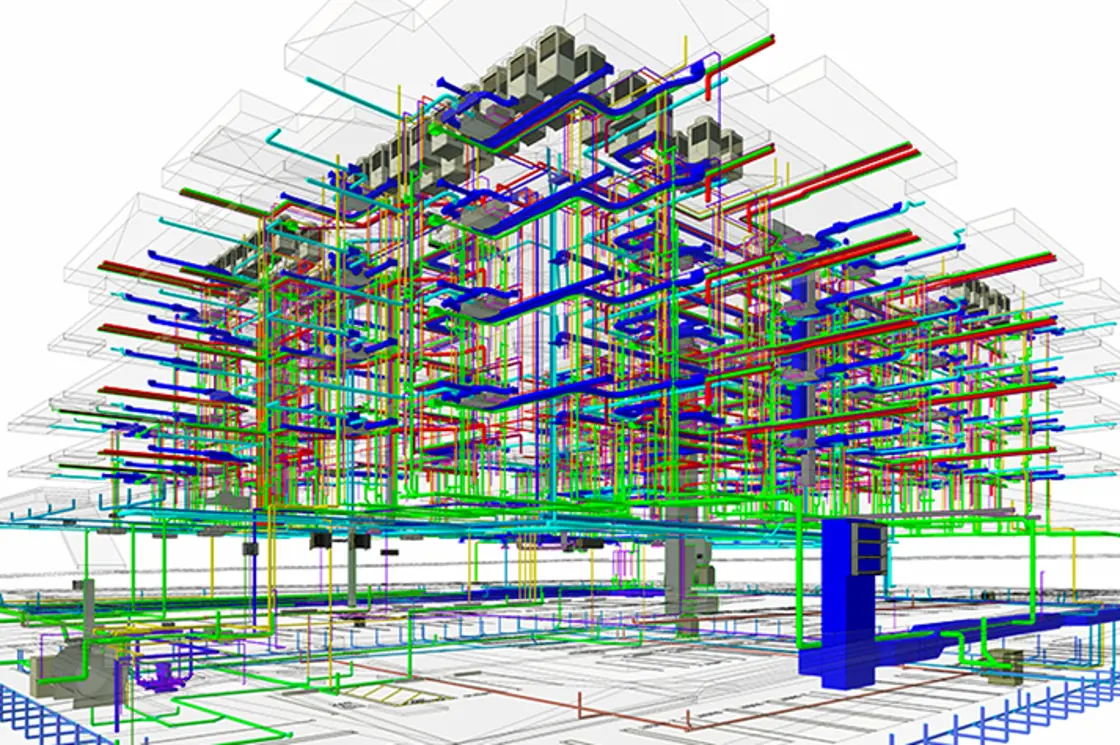
3D modeling revolutionizes Mechanical, Electrical, and Plumbing (MEP) systems by creating realistic virtual representations of building infrastructure. It improves project outcomes, streamlines workflows, and enhances coordination throughout the construction lifecycle.
In modern construction, Mechanical, Electrical, and Plumbing (MEP) systems are essential to any building. At ASquare Technologies, Digital Construction for MEP revolutionizes how we design, coordinate, and install these complex systems. By harnessing advanced 3D modeling and digital tools, we create highly accurate virtual representations of all MEP infrastructure. This approach allows us to achieve early clash detection, precise material take-offs, and optimized installation sequences, drastically minimizing errors and rework on-site. The result is a more efficient, cost-effective, and sustainable construction process that delivers superior building performance and a streamlined project lifecycle for our clients.
⚙️ Pre-fabrication
Off-site fabrication with higher quality control and faster installs.
📑 Fabrication Drawings
Accurate drawings generated directly from 3D models.
♻️ Material Optimization
Precise material take-offs reduce waste and cost.
💡 Energy Efficiency
Optimized designs for long-term operational performance.
Software Tools We Use
DJI Terra
Drone flight planning and real-time 2D/3D mapping.
Global Mapper
Advanced GIS analysis and 3D visualization.
QGIS
Open-source GIS for spatial data editing and mapping.
Agisoft Metashape
Photogrammetry software for generating 3D spatial data.
PIX4Dmapper
Industry-standard drone photogrammetry platform.

Delivering transformative, cost-effective surveying and geospatial solutions to support development, compliance, and innovation.
Get In Touch
Flat No:203, 2nd Floor, Arien Apartments,Panjagutta Officers Colony, Hyderabad – 500082
D.No 52-1/16-5A, NTR Colony, Rd Number 4, Gunadala, Vijayawada - 520008
+91 80084 30439
info@nscllp.in